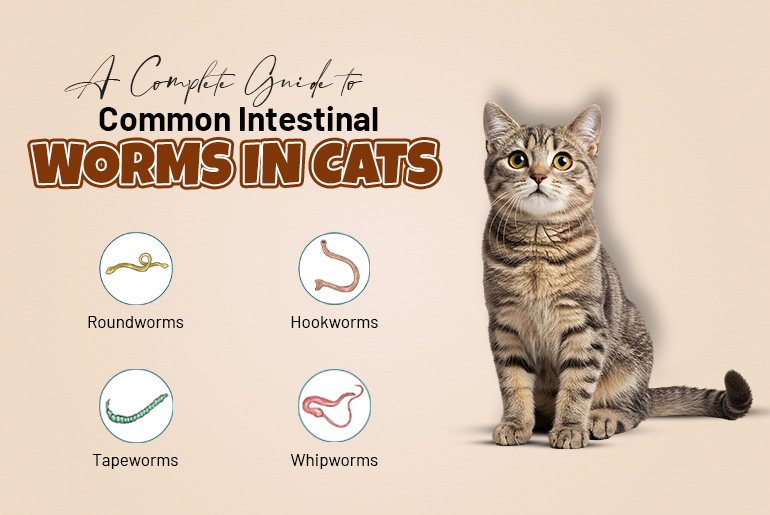
Is your cat losing weight despite eating normally? Or have you spotted something unusual in their litter box? These could be signs of a worm infection. Both indoor & outdoor cats are exposed to worms at some point in their lives. Intestinal worms are more common than many cat parents realize; you may find roundworms, hookworms, tapeworms, and whipworms.
Your cat may seem completely fine from the outside, but these internal parasites are hiding and feeding inside your cat’s body, so you won’t be able to notice them in the beginning. That’s why, it’s important to understand where they came from, how they affect your cat, and how to treat them.
Let’s dive deeper to learn more about intestinal worms in cats!
4 Common Intestinal Worms in Cats
1. Roundworms
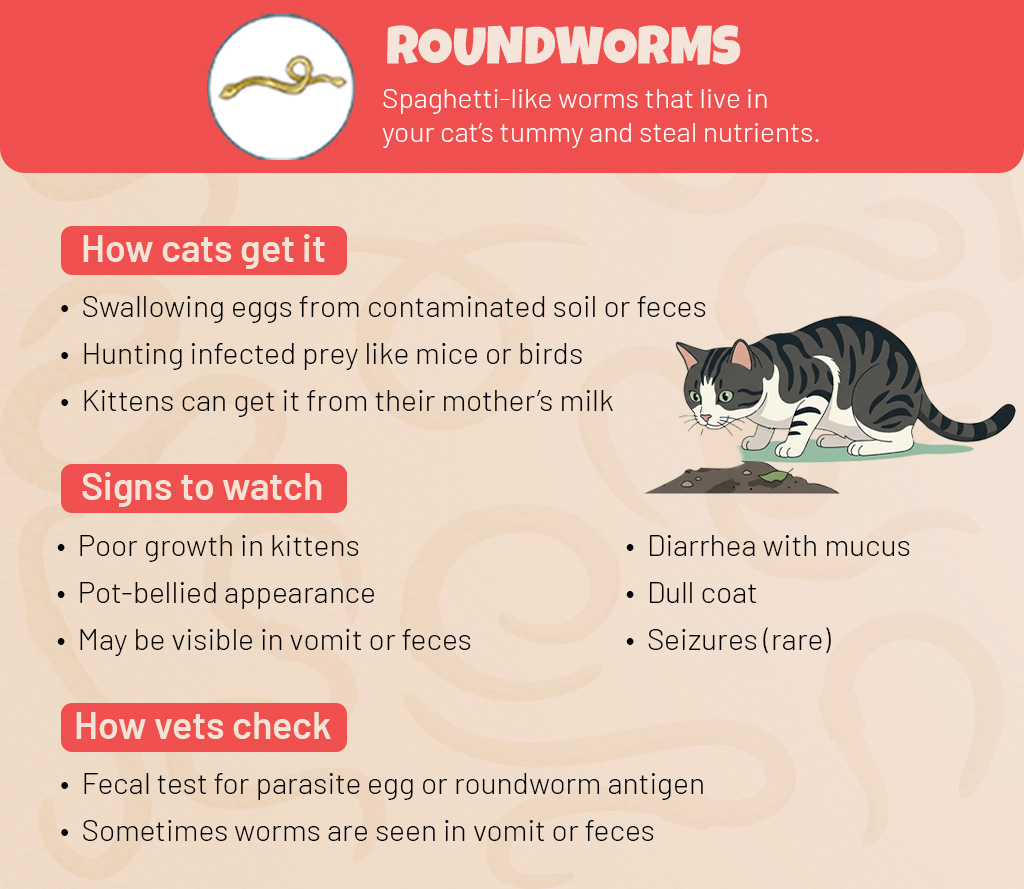
Roundworms are among the most common intestinal parasites in cats, especially in kittens. There are three species of roundworms: T. cati and T. leonina occur globally, and Toxocara malaysiensis in parts of eastern Asia, which infect cats. Adult roundworms are cream-colored and resemble spaghetti, typically ranging from 3 to 15 cm in length. The most common species, Toxocara cati and Toxocara canis, are zoonotic and live in the small intestine and absorb nutrients from the cat’s body.
How do cats get roundworms?
Usually, a cat is infected when it ingests roundworm eggs from the environment. This happens when a cat grooms after stepping in contaminated soil or feces. Cats can become infected when they hunt wild prey (intermediate host), carrying larvae such as rodents, birds, cockroaches, or earthworms. If an infected female cat gives birth, their kittens can become infected from their mother’s milk (trans-mammary infection).
Symptoms of roundworms in cats
- Poor growth (especially in kittens)
- Dull coat
- Pot-bellied appearance
- May be visible in vomit or feces
- Diarrhea with mucus
- Seizures (rare)
Diagnosis of roundworms in cats
It may include a physical examination, noticing adult parasites in vomit or feces. You may be asked to bring in a sample of your cat’s stool to the vet. After collecting, your vet examines your cat’s feces for parasite eggs or roundworm antigens.
2. Hookworms
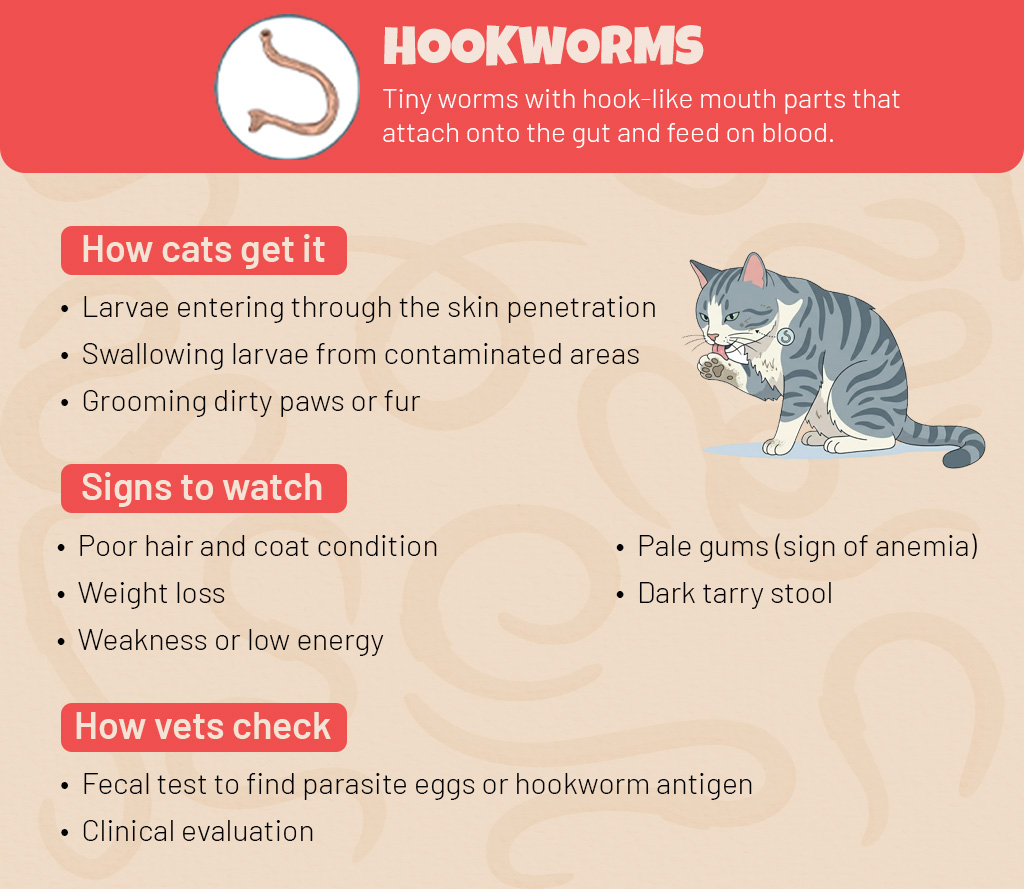
Another common intestinal parasite that can affect cats and kittens is hookworms. The common hookworm species Ancylostoma tubaeforme affects cats throughout the world, and Ancylostoma braziliense are found commonly in warm coastal areas. Compared to other intestinal parasites, hookworms are very small, around ¼” to ¾” (1.0-1.9 cm) long, which makes them harder to spot with the naked eye. As per the name, they have a hook-like mouth that attaches to the lining of the intestinal wall and feeds on blood.
How do cats get hookworms?
Hookworm larvae can penetrate a cat’s skin after walking or lying on contaminated soil. The larvae that enter through the skin migrate through the body to the lungs and intestinal tract. Cats also get most hookworm larvae through oral ingestion while grooming themselves or hunting infected prey. After being swallowed, larvae gradually move to the intestine, where they mature into adults.
Signs of feline hookworm infection:
- Poor hair and coat condition
- Weight loss
- Weakness or low energy
- Pale gums (sign of anemia)
- Dark tarry stool
Diagnosis of hookworm in cats
Just like roundworm diagnosis, your vet may look for clinical signs and ask you to bring your cat’s stool sample. Microscopic examination of parasite eggs or hookworm antigen in feces is performed. Through the fecal flotation method, your vet may check for thin-shelled, oval eggs in fresh feces from infected cats.
3. Tapeworms
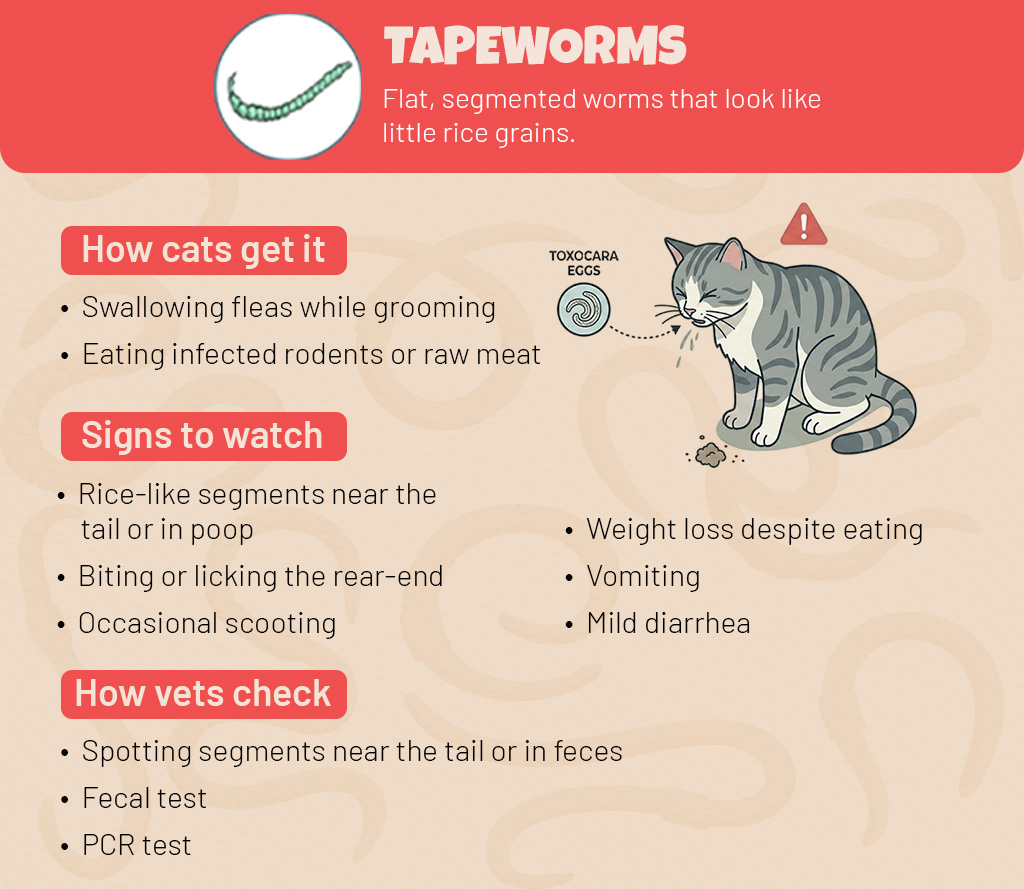
Most cats are affected by the common tapeworm species Dipylidium caninum and Taenia taeniaeformis. Adult tapeworms are long, flat, segmented parasites that may reach lengths of up to 11 inches (30 cm). The tapeworm segments look like grains of rice or cucumber seeds. Tapeworms are generally more annoying than dangerous in mild cases. It can lead to malnutrition and weight loss if left untreated.
How do cats get tapeworm infections?
In most cases, cats with flea infestations are highly susceptible to tapeworm infections. Cats ingesting a flea carrying tapeworm larvae while grooming can get infected. Outdoor cats eating raw meat or hunting more tapeworm hosts like rodents, mice, or other prey animals can also often contract tapeworm infection.
After ingestion, the larvae develop into adult tapeworms that attach to the intestinal wall. It grows and produces eggs in a segmented body that passes through the cat’s feces. Fleas then ingest the eggs from the feces and move to another host, spreading the infection further.
Symptoms of tapeworm infection in cats:
- Rice-like segments near the tail or in poop
- Biting or licking the rear-end
- Occasional scooting
- Weight loss despite eating
- Vomiting
- Mild diarrhea
- Visible segments around the anus or tail area
Diagnosis of tapeworm infection in cats
Tapeworm diagnosis includes finding visible segments or proglottids in the feces. First, your vet may check for visible tapeworm segments on your cat’s rear end. However, it’s quite hard to detect with routine fecal methods. A PCR test is required.
4. Whipworms
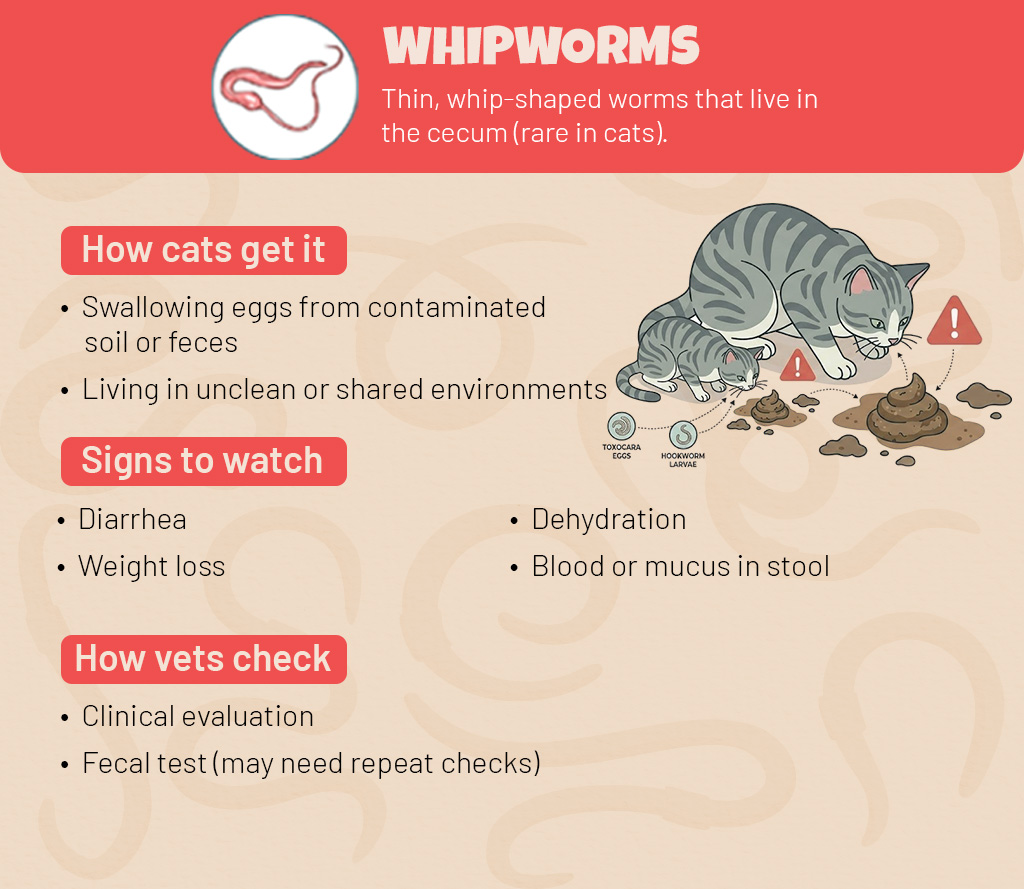
Whipworms are rare intestinal parasites in cats, compared to dogs. In cats, whipworm infection can still be caused by Trichuris spp. Whipworms have a 47-75 mm long, whip-shaped body structure. They commonly live in the cecum (a pouch that forms the first part of the large intestine), where they cause severe irritation to the intestinal lining.
How do cats get whipworms?
Whipworm’s thick-shelled eggs are passed in the feces and can become infective for 1 to 2 months in a warm, moist environment. When your cat is exposed to unsanitary outdoor environments, they can swallow eggs from contaminated soil or feces. After ingestion, the larvae hatch and mature into adults in the intestinal wall, completing their life cycle. Cats sharing litter in multi-pet homes are also prone to whipworm infection.
Signs of whipworm infections in cats:
- Diarrhea
- Weight loss
- Dehydration
- Blood or mucus in stool
Diagnosis of whipworms in cats
Whipworms are diagnosed by microscopic examination of feces for parasite eggs or whipworm antigen. However, it requires multiple examinations, as they shed a small number of eggs at irregular intervals, which makes diagnosis difficult. Newer testing that looks for whipworm DNA in the feces is more effective.
Worm Treatments for Cats
Roundworms, hookworms, tapeworms, and whipworms in cats are treatable after diagnosis, depending on the specific type of worm infection. Your vet begins with multiple anthelmintics, also known as dewormers, for the treatment. These dewormers come in chewable, spot-on, or injectable formulas to treat various types of worm infections. Some of the popular dewormers for cats include:
- Drontal
- ParaGard Wormer
- Droncit Spot-On
- Milbemax for Cats
- Triworm-C Dewormer
- Milpro All-Wormer
- Aristopet All Wormer Tablets
- Panacur Granules or Oral Suspension
Your veterinarian will help you find the appropriate worming treatment for your cat.
On the basis of the severity of worm infection, some worms can be treated in a single dose, or it may require repeated dosage of an anthelmintic given on a schedule over a certain period. Along with treatment, your vet will do routine fecal monitoring of infected cats to ensure the efficacy of dewormers.
Worm Prevention in Cats
Taking preventive measures is always better than treatment. Your veterinarian may recommend routine deworming based on your cat’s lifestyle and risk factors.
Ways to prevent your cat from getting worms:
- Use vet-approved dewormers for cats.
- Treat your cat’s environment, too.
- Clean your cat’s litter box on a regular basis.
- Clean their food bowls, bedding, and blankets daily.
- Treat your cat and other pets with regular flea treatments.
- Ensure that you follow deworming schedule for all pets living in your home.
Natural remedies are not proven to treat worm infection effectively, and it may worsen the condition. Talk to your veterinarian to find out the right worming treatment for your cat. Please follow your veterinarian’s advice for safe and effective results.
Final Thoughts
That’s all about common intestinal worms that can affect cats, so be aware of the signs of particular worms. Follow regular vet check-ups to keep a check on your cat’s health. Immediate diagnosis with proper treatment saves your cat’s condition from becoming worse and also helps protect other pets and humans. Make sure you maintain good hygiene and follow the deworming schedule to keep your cat healthy. You can explore a variety of deworming treatments for cats at CanadaPetCare at competitive prices.